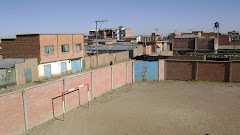
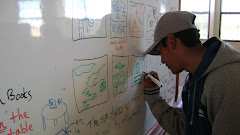
This past week I had a great opportunity to visit some of the FAO’s star projects which they’ve implemented in a number of other countries. The idea is for families to grow their own food with family green houses. The context here is urban, something I haven’t experienced yet ( I have visited a number of rural greenhouses). The program is truly fascinating. Working with the local mayor’s office, families can apply for and receive all the materials for the construction of a green house. They also receive free training and technical support. The benefits are obvious- you remove yourself, at least partly, from radical global changes in food prices, you know the quality of the product you eat, you can create a small surplus to sell to neighbors or in the market, and you drastically better your diet by having a variety of vegetables.
After a first day of visiting the large plot in the middle of the city where the FAO has their research greenhouses ( far larger than family plots and unfortunately in the process of being moved because the city is about to build a judicial building there), and visiting a couple families’ greenhouses in the periphery of the city, I absolutely loved what I saw.
So I signed up for a two day intensive training course on how to set-up and maintain your own personal greenhouse. A number of beneficiaries had their greenhouses built, but still needed training. This would be the last training session, so I was lucky to find out about it when I did. I tagged along and has an inspirational experience.
We learned two forms of planting- hydroponic and organic. Some of the themes included how to maintain humidity levels, when to water, what ingredients and ratios you need for your soil base, how to diversify crops, how to create organic pesticides, how to maintain heat in below zero temperatures at night, how to clean and maintain plants, and probably coolest of all how to use all recycled materials.
In the context of the altiplano which is cold, high, and barren, these greenhouses are beautiful. It does have its uphill battles- families don’t like the change in diet from rice, pastas, and potatoes to more veggies. It takes work to maintain your tarp and produce what you need. If you don’t like what your growing you don’t see the incentive to grow. But for the families who carry through with it, they have seen great results overall.
A FAO Greenhouse

One of the members in my training group taking a look at a plot of lettuce
Another Visit With QBL
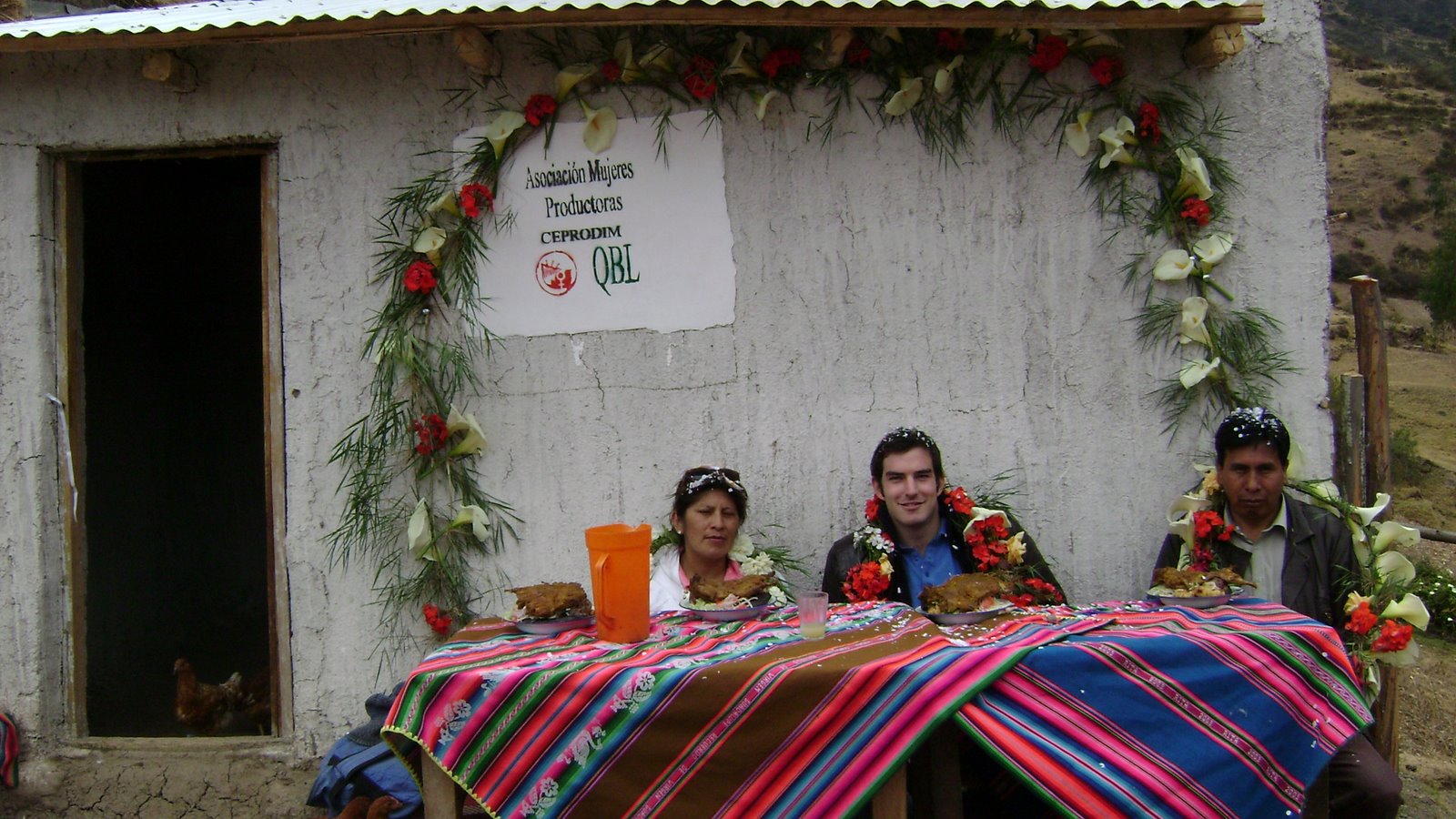
We visited the innaguration for a series of new chicken coops QBL financed in a small village in the low-lying andes mountains, 7 hours north of La Paz
Sunday, August 31, 2008

Flood Assistance Through The Food and Agriculture Organization of the UN
A Rotarian from Rotary Sopocachi, Einstein, presented a problem to the club a couple weeks ago concerning flood victims in Beni, a amazonian department north of La Paz. Between Jan, and March of this year they received a second year of record floods. They lost everything.
The FAO already has a project they’re working on there to rebuild houses and start up some basic turism. Still, they have many things they aren’t able to fund as their mandate/ mission restricts them. Therefore we’re working on a much more comprehensive and truly sustainable project which would include the building of schools, solar panels, improving means of communication including an early alert system, and looking into alternative economic activities besides livestock and farming. Finally I have a truly good feeling about this project- as mentioned I’ve work on a couple other projects that haven't moved past a proposal like one that would have created a youth technical training and academic tutoring program in El Alto through Gregoria Apaza. Unfortunately, I learned you need to find the right organization to take something from ideas to action.
With the FAO it’s another story. No more meetings cancelled at the last minute or simply forgotten- no more closed access to and/or entire lack of important information. It's delightful.
My role is translation, investigation of prices, hopefully a trip to the site, fundraising in the U.S. including contacting and presenting the project to rotary clubs.
Essentially, the only thing we need now is some strong Rotary backing, something I hope I’ll be able facilitate.
English is Growing on Me
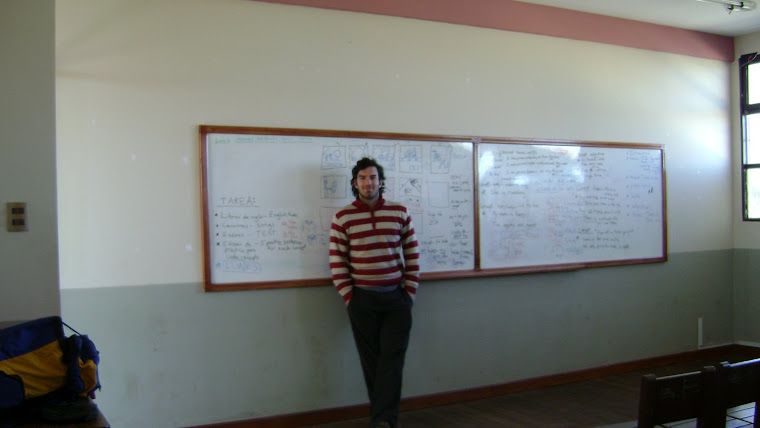
My class has grown! I now have at least 15 regular students. After changing my teaching times to the afternoon students who couldn't come because they were in regular HS classes now can. Thankfully the director of the CRP ( educational resource center) was either fired or left. Although he was a very nice man, it was probably for the better. The new coordinator is definitely on top of things in comparison and even provided me with some good teaching materials like video and cassette listening activities. So now I will be teaching a two and half month intensive English class. I’m trying to focus on themes like pronunciation and basic conversation because the kids are of all different levels. Some have had one year, some three.
Needless to say its fun! Although they have yet to take me up on Friday “party”day where they can bring in English music with the lyrics so the whole class can practice listening/ pronunciation, I hope this upcoming week will change that.
Needless to say its fun! Although they have yet to take me up on Friday “party”day where they can bring in English music with the lyrics so the whole class can practice listening/ pronunciation, I hope this upcoming week will change that.
As my time here comes to an end I thought I’d update a brief list of some of the more memorable moments among the Rotary Community. Among house dinners, regular meetings, small conferences, and workshops, these are a few I enjoyed the most
Offroad!
The President of Rotary Chuquiago Marka invited me one Wedneday for a day of offroading! He’s a member of a 4x4 group and they have excursions every once in a while. So around 10:00 on Saturday we left in a caravan of some 50 SUV’s of all varieties. We traveled up toward la cumbre which is a slowly fading glacier block. The region climbs from la Paz among jagged mountains that create a border between the altiplano and los yungos, a subtropical low-andes mountain region. A great day! I'll upload photos- hope the link works!
Children’s Hospital
With Rotary San Jorge I visited the burn victim and cancer childrens unit to distribute blankets for visiting parents ( who sometimes traveled over 6 hours to be with their children and had little to no family or friend contacts in the city) and to spend some time with the kids. We had a great time but hard it was to see how much they were in need/pain. At least we were able to spend one afternoon and from what I understand, they received frequent visitors. After talking soccer with a number of the kids and their parents, I established my minority status in favor of The Strongest, long foe of Bolivar. A great Saturday afternoon!
Children’s Painting Festival
For months Rotary Sopocachi planned a childrens painting course in one of this cities main plazas along with a midday cookout. I visited 9 schools to meet with directors about the event and make sure as many students as possible could participate. We hosted over 150 children and their families along with many Rotarians from other clubs.
Students competed in different age groups and all were up to win a series of prizes at the end of the day. I converted myself into the MC, announcing time changes, helped distribute drawing materials, answered questions, and selling food tickets for the cookout. With my Rotary sopocachi cap and two posters taped to my front and back I corralled lost children and recruited new participants, as well.
Rotary National Conference
In May we had a four day conference which had been the central topic for most of the weekly rotary meetings I had been going to since I got here. It was a national conference and representatives from every part of the country were present- over 300 people. It was somewhat unsure what the turnout would be considering the political situation dividing the country here but was a great opportunity to exchange ideas, for me to plan trips to make presentations all over the country and to listen to varied accents. It featured inspirational speeches from Rotary International's regional representative and a number of informational speeches about Rotary's programs. One day was the orientation for new officers and involved sharing ideas about the district's goals for the next year. Got an idea of the heirarchy of the organization and some of the successes / challenges that face clubs in the next year.
One of the best days was when they invited reprensatives from the UN and the head of the Museum of Natural History to make presentations on The Effect of Climate Change and Climate/ Health Policy in Bolivia. From there we spent the afternoon discussing projects from all over the country and ended with a "rain of ideas" ( the spanish version of "brainstorm") about creating a national agenda for addressing those issues. One table was to be only english speaking- a large contigent from California, Oregon, and Canada were in attendance. The rest were to be loosely topic based- waters projects table 1, education table 2, etc. etc. What happened, however, was that all the tables converged into the English Speaking table and we presented over 60 projects in English- I was the in house translator. Basically we just read a profile of the project- sutainable water projects, malaria eradication 5 year plans in Beni, health policy in schools, etc. It was a great exchange although I'm not sure about how and if they'll come to fruition- each project would have to apply through the Rotary international matching grant program in which co-sponsor clubs in the U.S. France Japan etc. and the foundation provide the bulk of the funding.
On saturday we had a "dia del campo" which was a big ole cookout. A beautiful day and tons of fun after all day everyday Rotary for four days- One highlight was the talent show. On one level it was formal in that Rotarians danced traditional dances in traditional clothing typical from each region here to welcome all the guests. The other part was open mic. For those of you who know me or of me, I couldn't resist. Indeed it was my ambasadorial role! So I sang John Prine's Paradise/ Muhlenburg county on guitar- it's been a while so I was rusty but it was an overall success. Bluegrass was something a bit foreign to many in attendance.
Monday, August 25, 2008
How many Bolivias are there?
President Evo Morales won recently in what historically should be considered a landslide with some 67% national support for his administration through the Referendum Revocatorio.
At the same time many of his political enemies- the prefects of Santa Cruz, Tarija, Beni, and Pando also won by a substantial margen, all over 50% with Costas from Santa Cruz winning some 70%
The biggest issue is the IDH or the tax revenue generated from oil/ gas which was “confiscated” by Morales to support his national social security system that gives about 240 bolivianos monthly to citizens over the age of 65.
In the macro, you see the battle between autonomy and nationalization. But the nuances sometimes aren't that easy to nail down and a long history of transitioning since 1996 from a national to a descentralized government has meanth new changes and new political dinamics. This transition has had support from the World Bank, the U.S. and others. Still, Hugo Chavez has been closely allied with Bolivia which has helped it's ability to create/ support health and education programs/ support for nationalization. It also means having leaders at least rhetorically against the U.S. and the "west." Still, although Venezuela is giving millions to Bolivia, much of it still comes through lones with interest. Nationalization is an ambiguous term as well because it still allows for private management that is essentially contracted out. Just like the "nationalization"of the largest telecommunications company ENTEL still allows for the management to remain and for non-state agents to run the business. As most issues here, the argument is over distribution of wealth.
Morales may have a political mandate but doesn’t appear to have a blank check.
Before the vote airports were closed by groups protesting against Morales in Santa Cruz, Tarija, and Pando. Now the prefects of Tarija, Santa Cruz, and Chuquisaka have declared they will create blockades leaving the country to Argentina and Paraguay in protest of the IDH. There have been threats in the past weeks that civic groups including some newly "youth civic groups" will take state offices and departments. At times its hard to see these "youth groups" in a serious light. They have no respect for law - they've burned police cars in Santa Cruz anddon't appear to support an intellectual agenda usually forwarded by a "student movement."In Tarija the customs office was "taken"for a short period and groups alined with MAS have said they will defend state offices. Still, I need to read up on these youth groups and excactly who are the "civic groups."
Morales recently declared that if oil ducts, state oil field, etc. are taken or damaged, etc. they will confiscate all municipal funds if political leaders from those regions participate. That includes if people are injured.
Again, the issue is the tax revenue generated from Oil/ Gas revenues, the IDH. They want some 166 million dollars to be returned to their local governments that has been used for Morales Renta Dignidad plan.
We shall see how it goes. But the rhetoric is somewhat tense with groups being clear in not ruling out violence.
Wednesday, June 4, 2008
Sifting Through the Political Situation
Here are some impressions of mine about the current political situation. I got a number of emails asking me how I was and if it was still safe here especially last may 4th. SO......
The press isn´t amping it up- the country is divided. As far as how the press from the Nytimes describes the race relations I think they're prettyclose. As for the underlying economic and political relations, they get it sometimes although if you've read as many articles as I have over the past 4 years from the Times, they like to recycle information, phrases, impressions, and political summaries. I'm about 2/3 through the new constitution that was passed in dec. 2007 by Morales' party MAS in Oruro. It's dense, long, and more like a massive public policy document as opposed to a general guideline; it creates a national health care plan, land distribution, state control of telecommunications, and natural resources to name a few. It is somehwat under scrutiny because some of the constituent delegates who weren't with MAS or opposed to their proposal left the table after MAS lost the 2/3's vote on their version. At that point MAS tried to change it to a simple majority to pass it and thats when the other delegates from Santa Cruz and other deptartments left. Still, from most accounts, the constitution is considered legitimate although controversial ( I'm still trying to piece things together).
So on may 4th Santa Cruz decided to have a referendum on their autonomous statutes which I am in the process of reading- more or less it would involve much more local control over natural resources like gas and agriculture. They would also have their own police force and would recognize only a couple indigenous communities that are original to their dept. as ¨original¨or indigenous, as opposed to immigrants from la paz or other depts. who have moved there in more recent times. The referendum is not legitimate from most anyone's perspective but some give it "legitimacy"because it's a show of public opinion. Although about 38% of the people abstained( a couple voting stations were blocked by protestors but it wasn't overly significant), 85% of the people who did vote were in favor of the statute ( the vast majority of whom hadn´t read the actual statute nor the new constitution).
Some say Santa Cruz is crying over the fact that they have to pay taxes to the state and give up more control to the state- they're the economic engine of the country. Addittionaly, blatant racism exists in those regions as in much of the country. Demographically and many times economically speaking it's a "naturally" divided country. That has been the case for it's entire history, however.
On one hand, you gotta love Evo Morales. He's the first indigenous president and therefore in a crude way represents the 60% of the country here who consider themselves indigenous. He's radical but won in landslide victory two years ago- people wanted a change from failed neoliberal economic policies, sovereignty from the developing world including U.S. policy preferences, and the ability to control natural resources. If you've read anything about "development"after the 2nd world world, the failing war against drugs, the massive unemployment resulting from neoliberalism, and the drastic economic crisis in Bolivia in the past 10 years- you sympathize in a lot of ways. Of course there are good sides to the reforms in the 90's like bilingual education from '94 and the improved status of women. I won't get into the long and complicated discussion here. Still, Morales is controversial.
When it comes to Democracy I'm not sure if I agree with Morales since a large number of people in other departments want some kind of autonomy- more than the current constitution affords. For example, Pando and Beni recently voted for autonomy and of those who voted about 80% were in favor of the statute while obviously more or less 20% were against. At the same time, there was about a 30% abstention rate. Morales has pointed out in these votes that the abstention rate combined with the "no"vote still supports his position against autonomy- some 50% of the population in one way or another against it.
Morales is in a very tight political position and is gonna have to negotiate at some level since it is clear there are significant divisions. On August 10th Morales has called for a Referendum Revocatorio- he's offering himself and the departmental Prefects up to the people for a vote of confidence. The prefecturas, for the most part, are opposed to Morales and act as the primary filter for funds from the State among other things.
In a country where poverty is so high I think the state has to step in and allow for capitalism to do its job but, as one can see in any developing country, the state has to take a significant role ( see Michael Mann or Peter Evans among others for some fun reading).
The debate is fascinating. For example, the new "MAS"constitution limits the amount of land people can have and would distribute land to mostly poor indigenous communities (I believe it is 10,000 hectares limit per person). It also allows for indigenous judicial rights within their community. Is that limiting personal rights or saving peoples lives and giving them some land to grow food on? Is it more in line with the Andean Cosmovision/ Communitarian vision? Is it against the liberalism most "modern democracies" are based on? If so, how would it respect personal freedom i.e. individual rights? Is there a system that's entirely capitalistic and market based- one that doesn´t control prices( note: the U.S. and corn markets especially considering ethanol subsidies) and land?
Another example: I don´t agree with Morales' periodic ban on exports( perhap I don't understand the economic rationale). He recently did it with oil ( cooking) a couple months ago in Santa Cruz because the internal market prices were too high. Just a week or so ago they limited the export of chicken and certain types of cornmeal. The gov. has a regulatory agency that supposedely knows what the market price should be. Therefore Morales by decree can ban exportation ( in the case of oil some estimates say they lost 100 million dollars because of the ban). About a month ago, they came to an agreement with producers in that they should sell domestic oil at a certain price and export at whatever they wanted sighting the ¨just¨price for a population so impoverished. These kind of agreements/ issues many times baffle me and are indicative of the incredible difficulty in finding a middle ground.
In a world of such hardball politics compromise is difficult to come by.
Overall, there have been spurts of violence. On may 4th things were calm in la Paz although there were marches in most places especially SC, dept. of cochabamba, and El Alto. A few injuries but major violence wasn't a problem. Things shouldn´t get bloody but they might get ugly. I'm fine in La paz for now, but no one knows whats in store for the country in the coming months.
I hesitantly express my opinions- sometimes the papers get it right, sometimes they don't. Sometime's what you hear from people is, as with many political discussions, misinformed and based on opinion or hearsay. Amid this tangled discussion and situation, I'm just trying to keep up on whether my favorite soccer team "The Strongest" ( Mascot, The Tigers) is still losing. And they are.
TIGRE, TIGRE!!
Tuesday, May 13, 2008
Dancing on the Altiplano
A few Thursdays nights ago the president of Rotary Club San Jorge gave a great inspirational presentation to club members and invited guests. He explained the international and national role and achievements of Rotary coupled with what could make the club even more effective.
Afterwards I chatted with a number of Rotarians about service, the meaning of giving to others, and occasionally we dipped into more philosophical discussions. I always enjoy certain aspects of the Buddhist outlook- that we are simply a reflection of others- diamonds in net that reflect our setting. You serve just to serve as opposed to helping others in pursuit of selfish fulfillment (in my opinion, hard as heck to remove selfishness when it’s tied to the happiness of helping. At this point we could begin a fun discussion about society, the self, and the reality of theories in practice).
So after a delightful night I ventured home and watched a bit of a movie- I was nearly in bed when I got a call from the president of Rotary Miraflores, El Capitán- “Yohn! Manana vamos a pachacamaya con QBL- 8:30, plaza triangular!” Le digo “estaré allí, plaza triangular 8:30, por supuesto!”
Rotary provided the funding for more than 20 water pumps in a small community of 25 families and they were going out to see the final product.
We headed out to the site and met up with a couple members of the community who proudly showed their brandnew pumps- worked like a charm. The community did all the work with the help of a technician; Rotary/ QBL helped put up the funds.
The plan was to grab lunch in the community hall- meet up with the families, etc.
Before I knew it, I was swept up by a beautifully dressed woman in a traditional poncho, small felt hat, a flowing colorful skirt. Its tradition apparently to dance to the dining hall accompanied by flautists (These flautist were our musical performers for the rest of the day and wore traditional head dresses with plumes of feathers spouting off the sides).
Once we made it down the short dirt road and to the main community hall we ate a delicious meal of meat, rice, potatoes, and soft drinks. As we ate, the flutes continued and slowly the community trickled in, all told about 50 people. The leaders of the community said a few words, the capitan said a few as well, and from there the good times began. Since we had finished our meals and were celebrating, that meant some shared beers. It was by all accounts a modest affair, but it signaled the music and more dancing. The women who led us in at first swept us up from the table and we whirled around the small hall until the music stopped. We would rest for a few minutes, then once again the music started the dance and my 60-70 year old partner ( who had more energy than I did) grabbed my hand to dance. Bar far, the best discoteca I’ve been to so far.
Subscribe to:
Posts (Atom)