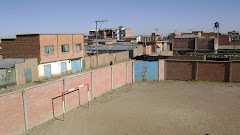
Last weekend I accompanied Rotary Club Miraflores to a small community about an hour south of La Paz on the Dia del niño to distribute toys and others items such as baseball caps. The community is situated near the river that flows north-south from La Paz in zona sur. In January the river diverted its course and innundated a number of houses, fields crops, and had a grave impact on the region.
We worked through a contact who was the leader of a recently formed children’s activity center (although I call it a “center” it was simply someone who cared enough to plan activities for the kids around their dusty small soccer field- from all accounts it had been a great success). All told we distributed items to more than 50 children from ages 4ish to 15ish. They greeted us with a covered tent area adorned with local flowers, two liters of pepsi and plenty of energy. Each child came up to us and shook our hand before getting a toy and a hat ( a display of manners the director was proud of). We then shared pepsi and some candy with everyone. All the kids were lined up according to age groups in single file lines. Once we finished up the formalities however, I, along with others, suggested we begin the real job at hand- challenging the locals to a little game of soccer.
The president of Rotary Club Miraflores, the Secretary of the club, myself, and a couple other kids formed one team- the other team consisted of entirely too talented 9-10 year olds equipped with high altitude lungs, discipline and the burning desire of champions.
After a 30 minute battle between the two forces, random searches for lost soccer balls in the brush, and a continuous stirring of dust, the match ended. Indeed I can’t remember who won, but it matters not. We’ve arranged to schedule a rematch in the coming weeks.
After we finished the game, a number of the families overwhelmed us with plates of delicious food! It was far too much for us to handle and made me feel even less worthy than I did already- a great morning!
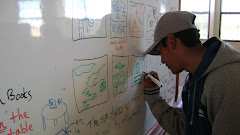
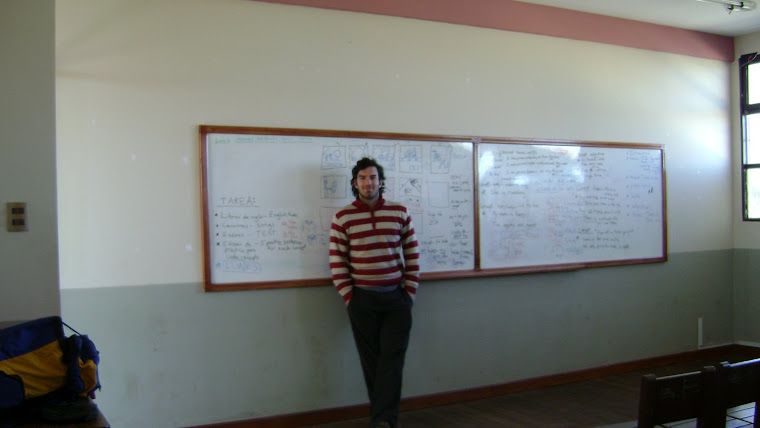
From there I went on to class where I did a presentation on the Spanish Colonial destruction of Andean territorial planning, culture, and daily life. Got to read some really cool laws from the 1500's. I'll try to write another blog about it!
A FAO Greenhouse

One of the members in my training group taking a look at a plot of lettuce
Another Visit With QBL
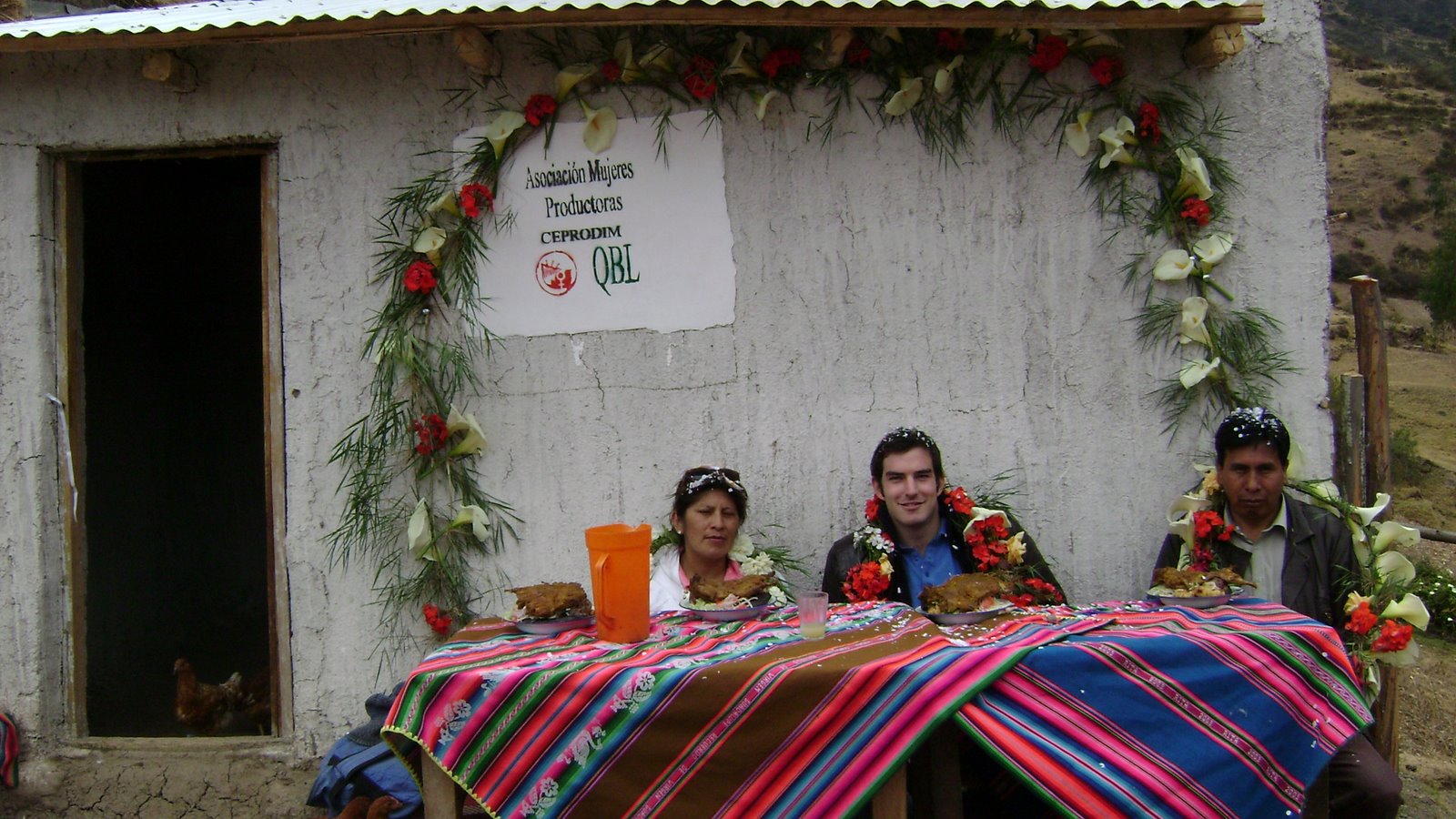
We visited the innaguration for a series of new chicken coops QBL financed in a small village in the low-lying andes mountains, 7 hours north of La Paz
Wednesday, April 16, 2008

Wednesday, March 26, 2008
Lake Titicaca
On March 15 I went with Rotary Club San Pedro to a small village near Lake Titicaca to distribute donations of more than 300 pairs of shoes, school supplies, and clothing. We got up early on Saturday morning and traveled with three Rotarians and two contacts we had with the village who had worked there as nurses. The drive took about 4 hours and included a brief ferry ride over a portion of the lake. A stunning, sunny, 60 something degree day surrounded us the entire time. We spoke with some of the leaders of the town ( some of the few who spoke Spanish) and they gave us a brief tour including a semi-finished plaza the local authorities had promised to finish. They also explained that the new expressway ( or Bolivian equivalent) would cross through or near their town a major boost to their local economy of artesanal weavings and agriculture.
We ate a communal meal of potatoes, corn, a garlic-salt cheese, ispi, and habas- delish. After chatting with the leaders some more we distibuted all the items we had and were presented with many thanks from an assorted group of leaders. A wonderdful experience and an even more wonderful Saturday evening when we got back to La Paz.....
The Tears of Change
Well I got my first taste of tear gas a couple weeks ago. I finished up a day at Gregoria Apaza visiting high schools to recruit for my English course I’ll be teaching at a resource center en El Alto ( they’re paying for my transportation which means about 3-4 buckaroos a week) I got back to La Paz late in the afternoon, taught an English class from 5:30-7:00 and headed to a café to grab some food before going to Rotary meeting around 8:00.
When I got closer to the café I heard the chants and shouting of the protest rally of “the pacifists”who were anti- Evo Morales. Through chants of “dictatorship NO, democracia, YES” I casually made my way through the line of police to the café a block away ( The issues are quite complicated and I’m careful to note that those chants might or might not be true).
Coffee Alexander is a trendy but nice shop next to my house and they have a killer Quinoa wrap. Around 7:50 I decided to head off to the meeting. Content with my excellent timing I neared the front of the store. It seemed to me that while everyone smokes everywhere whenever they can here, it seemed a bit much this time around. I also noticed a large group of people at the door with Bolivian flags, clearly members of the rally. Finally I noticed a man with bulging red eyes and snot running from his nose. Soon I was smacked in the face with a thin, burning, irritating feeling in my eyes and I quickly headed to the back of the store. Indeed, it was tear gas.
Turns out the police decided to break up the rally which eventually turned semi-violent when supporters of Morales (Masistas) showed up. A few car windows, and windows of a nearby university were broken, and a couple people got hit with rocks being thrown.
This I found out the next day. Of course, no worries mom, I waited in the café till all was clear, went to my apartment and made a delightful cup of tea…….
Tuesday, February 26, 2008
Potable Water in Sorata with Miraflores
Rotary Club Miraflores donated more than $3,000 with the help of Rotary clubs in the U.S. to a Potable water project in a small village in the hills/ mountains of Sorata, a farming community about 3-4 hours outside of La Paz. They teamed up with a Quaker NGO that did the coordinating of the project and helped the families with technical assistance. The people in the community did all of the manual labor and built the piping, tanks, and distribution themselves.
So last week on a Friday we got up early and headed for Sorata at 7:30 for the inauguration ceremonies. El capitán, a naval retiree, is the president of Rotary club Miraflores here in La Paz and was the special guest along with two reps. from the NGO.
This of course didn’t mean we would get there in 3-4 hours. Because of a shortage of gas, protestors in El Alto( the sprawling city above La Paz through which the only road from La Paz runs through), made a bloqueo so we were stuck in a sea of sardined minibuses, taxis, and 1940’s dodge school buses for about an hour.
We were led by Rigoberto who we casually called Rigoberta Menchu. He took the role of holding my life in his hands as our loyal pilot ( he was a real pilot too). I saw the true altiplano for the first time and the massive mountain ranges that line it on both sides. Absolutely stunning views, I’ll post some pics once I get them. We passed through a number of small towns and finally made it to another mountain range we had to cross before going back down the subtropical level of Sorata.
As it is the raining season there were massive blocks of fog, derrumbes ( land slides), and no guardrails as we whipped around switchbacks thousands of feet in the air. Once we began our decent the weather cleared up and we entered into the overwhelming subtropical andes. Although we made it through the fog and barely manageable roads that didn’t mean things would get better i.e. I wouldn't be on the verge of death. Instead we climbed another 30 minutes on extremely narrow and washed out, bumpy and, again, non-guard-railed pathways. Finally we reached a stopping point and hiked another 20 minutes to the location of the village passing small farms, hogs in the trail, and glimpses of the thin but forceful mountain stream in the distance.
All of the families were present and had set up a wonderful wooden fencing structure decked with beautiful flowers in front of a table on a plateu. The small terrace of flat land among the sloping hill overlooked an unbelievable view (pictures coming soon).
The ceremonies began with words from many of the village leaders who spoke Spanish but who’s first language was Aimara ( I might be mistaken, it might have been quechua, but I’m pretty sure it was Aimara). They thanked Rotary and the Quaker NGO and welcomed me as a representative from the United States. El Capitan said a few words of congratulations and we shared a communal meal (see list of things I’ve eaten). The men were separated from the women and children and we were seated on a long bench along the wood structure they put up.
The meal was delicious as we ate handfuls of multicolored popcorn and drank Tampico. Finally we climbed a slope to inaugurate the water tank. El capitan smashed a champagne bottle on the side, some of the younger kids tried to scare everyone with a firecracker and the families officially celebrated the first time they had had potable running water in their houses.
We then ate another meal called an Andean Breakfast ( see list of things I’ve eaten) and concluded with handshakes, saludos and a beautiful drive home.
(please note cheese del altiplano in the list of things I've eaten: el capitan stopped in a small town and bought us all a cheese disk and buns for an afternoon snack. Delicious!)
Rolling with Rotary
Rotary club Chuquiago Marka
Two Sundays ago I went to the house of a Rotarian to distribute some 23 wheelchairs to those in need. Together with Rotary clubs in North Carolina (working with the UNC business school) they shipped brandnew wheelchairs to La Paz and El Alto. Sunday around 10:00am we began the distribution and took a number of pictures.
We ate some salteñas after the event and the president of the club invited me to lunch with his family in the Zona Sur. We ate at the Bolivian equivalent to O’Charlies which I find kind of hilarious (the featured plate was Jack Daniels ribs to give you an idea). Funny story: ater some delightful conversation and jokes I excused myself to restroom feeling content with my spanish conversational abilities. I went to the doors that said Baños- easy enough right? Wrong.
Apparently because they are soo family oriented they have separate restrooms for kids- I was wondering why the sinks looks like airplanes and the latrine was painted like a pirate ship with princesses on one side and princes on the other. Luckily I caught myself and after a few jests from my hosts, we continued on with the day.
We dropped his wife and three daughters off at the Alasitas market which ended that day. He then gave me a quick driving tour of La Paz. He worked for Coca Cola here for 7 years and managed the distribution to all the corner stores or tiny little street vendors- we’re talking over 20,000 small markets and corner kiosks.
Needless to say he knew the city pretty well and took me to an overlook. He also said he’s be my guide for when family visits. More to come with him as I describe my birthday.....
Friday, February 8, 2008
Classes- Modulo 1
I attend classes in the south of La Paz, about a 15 minute minibus ride from where I live.
We are in a traditional classroom and I suppose it would be considered a traditional style of teaching- a lecture followed by discussion. Our professor is the executive director of a development group that empowers women through technical training, legal aid, psychological assistance, and other departments. I´ve met with her and have proposed some ways I could help out, notably with the exportation of their products( they are a microempresa).
There are officially 15 students in my class although the regulars usually number 11 to 12. It is comprised of economists, sociologists, historians, teachers of aymara and quechua, and turism specialists. We range from around 24- 50 or 60 years old. There are two Brasilians, a Japanese student, and two United States students.
We read articles and write a response paper for each class (three times a week, 3 hours a class from 7-10pm). Themes right now deal with Trabajo( work) and range from theory to history to politics to sociology. I´m also working on a research project on the teachers unions here in la Paz. Cool stuff since they take to the streets pretty often! I enjoy it all and look forward to the next modules such as citizenship, migracion, and economia.
Carnaval, Oruro!
La Diablada is the Carnavale festival in Oruro, about 3 hours south of La Paz. When people ask, Vas a Carnavale? By Carnavale they mean are you going to Oruro to lose two days of sleep, get soaked with water, and experience 48 hours of constant, costumed dancing in the streets?
There were about 70 or so people in our group split between two coach buses. Our sponsor was Tigo, a cell phone company so we were inundated with Tigo gear- a blue t shirt, a waterproof plastic cell phone pouch, a sleek blue poncho, and a slew of bandanas.
Our group was relatively diverse- ages ranged from about 19 or 20 to about 28,one of the organizers was Rusian, and the highlight was the Chileans on summer break. We got to know eachother and I´ve got an invitation to Santiago.
We arrived from La Paz near the plaza and piled about 9 people in a taxi which took us about 15 blocks to our Hospedaje on Friday.
Don't, however, assume that by "of course we've got housing, we rented a house" the organizers meant "we rented a house." It had walls and a door and a roof. We slept on sandbag mats and I brought a blanket from my apartment. One must not forget about priorities, however; dancing troupes, hamburgers, water balloons, and comraderie. Maybe some sleep.
For the first time in two weeks it wasn't raining which was a good thing since our three hour bus ride took five and Saturday and Sunday were beautiful!
Oruro is a town of about 200,000 people and it IS Carnavale. There aren't any big buildings except for one Hotel, Hotel Eden. As with many small towns of Spanish influence, there is one main plaza. Once you get within about 3 blocks in any direction of the square the dusty streets, very modest homes, street dogs, and occasionally a person or two vanish as a throng a people and beating of drums overwhelm you.
We sat in bleachers that lined the streets around the plaza and watched the parade with everyone in our group, easy to spot because of our blue ponchos. Communal chants, bizarre costumes, and tons of waterballoons marked the day. I ended up staying out late and got to see one of my Rotary friends dance as a Caporale! (note the wikipedia explanation)
I ate only burgers and fries at Superhamburguesa, a marginally good fast food join. One highlight was lunch on saturday when I ate Charquekan which is LLAMA! It was very good- you eat it with mato (not sure about pronunciation-spelling) kinda like big corn kernels.
Sunday we did it all over again and headed back to La Paz at 7:00 arriving around 11:00.
pics from last year ( MY CAMERA BROKE!)
http://orurocarnaval.com/FOTOS/thumbnails.php?album=19&page=6
a better explanation of its signifance than I could give:
http://en.wikipedia.org/wiki/Carnaval_de_Oruro
Subscribe to:
Posts (Atom)